
When objects arrive at the museum from donors, their condition can vary after years of appreciation by their original owners. While some objects come in excellent condition and appear good as new, others arrive in need of some good TLC. Such was the case with a recent donation of an Ellery Thompson painting, accession number 2025.39.
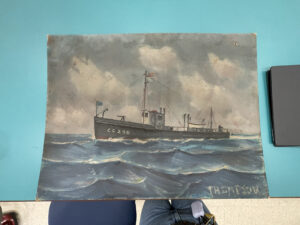
The painting depicts the United States Coast Guard Patrol Boat CG-290, which was involved in the high-speed chase and apprehension of rum runner Black Duck on December 28, 1929. At the time, Black Duck was the most notorious rum runner in the United States, and within its two years of operating, the rum runner and the Coast Guard had formed a bitter relationship. Unlike other bootlegging vessels, Black Duck was exceptionally fast; Charles Travers, the owner of the boat, had outfitted it with two V-12 Liberty aircraft engines – each of which produced 300 horsepower – making the Black Duck able to run at 32 knots an hour. It was later said that the vessel had a smoke screen and weapons, including poisonous gas, on board to further hide and deter the Coast Guard; however, these details are not confirmed. Ultimately, the Coast Guard did not have a vessel in its fleet that could keep up, and between the Black Duck’s color palette blending in with the night and the boat never being found with illegal alcohol on board, the Coast Guard never successfully seized the vessel.
On the night of December 28th, Black Duck was finally apprehended by CG-290 off the coast of Newport, Rhode Island, with 383 cases of illegal liquor.
Flash forward to 1980 when Ellery Thompson was inspired to paint the Coast Guard vessel. According to the donor, the painting had originally been gifted to a Stonington-based lobsterman by Thompson; the lobsterman then paid the donor’s husband with the painting in exchange for a hand-made lathe. In the 2025 donation offer, the donor wrote, “The unframed painting was hung in the wood-heated sawmill, so it needs a good cleaning.”
Having read up on the story about the CG-290‘s nighttime coop to seize the Black Duck, a dark and dingy colored painting didn’t seem too odd when it arrived in July of last year. The painting was catalogued as normal and set aside to be cleaned before going into storage. This was when we realized that the painting may have been slightly dirtier than we thought.
Using a “mild enzymatic solution,” more commonly known as spit (Yes, spit! Learn more about the use of spit in conservation here: Why We Sometimes Use Spit to Clean Paintings), I tested a small patch in the upper left corner with a cotton swab. Underneath, blue-sky.
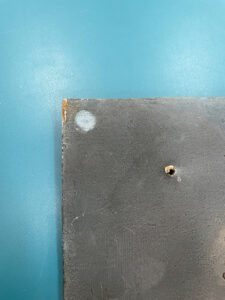
I continued cleaning…
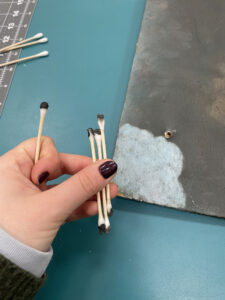
And cleaning…
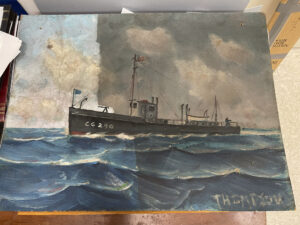
First a corner, then a side, section by section layers of residue were removed to reveal the clouded blue-sky Ellery Thompson originally painted. Take a look below at the painting halfway through its first cleaning!
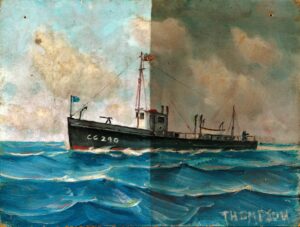
Every object requires a different level of care when it joins the Art and Objects Collection at the museum. Who knows what conservation techniques will be required next!
-Jenny Carroll, Collections Cataloger