
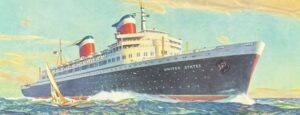
On the night of Wednesday, November 11, 2026, the internet was abuzz as people around the world watched the intentional and incredibly slow sinking of the once-glorious passenger liner, S.S. United States. It was, and still is, the fastest ocean liner to ever cross the Atlantic, and now, the ship will begin a second life as an artificial reef and destination for divers off the Florida coast.
Designed by naval architect William Francis Gibbs of Gibbs & Cox, a firm he founded with Daniel H. Cox of Cox & Stevens, the ship was built in Newport News, Virginia, and launched in 1951. Almost every state contributed to its construction and outfitting, including Connecticut, which provided clocks for the ship. The largest passenger ship ever built in the United States, it was also the fastest ocean liner in the world, carrying everyone from celebrities and artists to presidents on its record-setting transatlantic crossings.
The S.S. United States operated transatlantic voyages for United States Lines from 1952 until 1969. By the 1960s, however, the rise of commercial air travel had begun to take its toll on passenger liners. After the vessel’s retirement, it passed through several owners and spent decades languishing at docks in Virginia and Philadelphia while various individuals and organizations explored possible futures for it. Ideas ranged from converting it into a Hawaiian cruise ship to turning it into a museum. Eventually, Okaloosa County, Florida, acquired the badly deteriorated vessel, and plans moved forward to give it a new purpose as an artificial reef. S.S. United States will join numerous other vessels intentionally sunk to provide habitat for marine life and create destinations for divers and anglers. (To learn more about that, check out: Scientists are studying how ecosystems form on the world’s largest artificial reef | Woods Hole Oceanographic Institution and (PDF) Non-native molluscan colonizers on deliberately placed shipwrecks in the Florida Keys, with description of a new species of potentially invasive worm-snail (Gastropoda: Vermetidae))
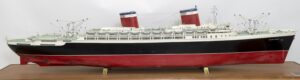
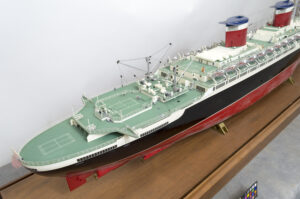
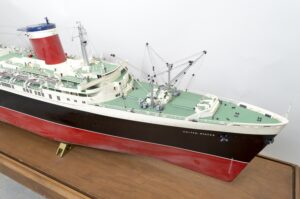
The recent news about the S.S. United States inspired me to dive into our collection and explore the many items we hold related to the vessel. The Museum has sixty items, mostly photographs and ephemera, along with one model.
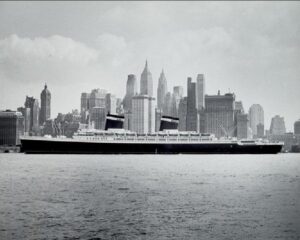
The Rosenfelds photographed the ship over the years, including this iconic 1953 image with the New York City skyline in the background.
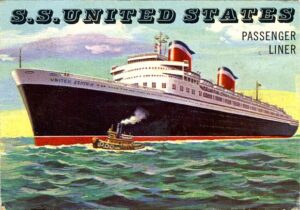
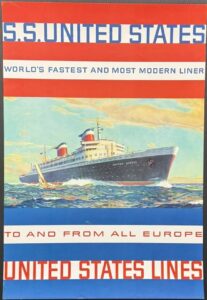
Our ephemera collection includes postcards and posters like the examples shown here.
Perhaps one of the most striking artifacts related to the S.S. United States is a meticulously detailed, six-foot model crafted by modelmaker Robert E. Heyman in 1965.
Though it is difficult for those of us who love maritime history to see yet another grand ship disappear, the S.S. United States will live on in the archives and vaults of Mystic Seaport Museum, as well as on the sea floor. Resting in approximately 180 feet of water in the Gulf of Mexico, with its upper deck about 55 to 60 feet below the surface, the S.S. United States will soon attract fish and other marine life. As curious fish explore the gaping holes that once held its enormous red, white, and blue stacks and marine organisms begin to settle on the hull, a new chapter will begin for this grand old ship.
–Krystal Rose, Curator of Collections