
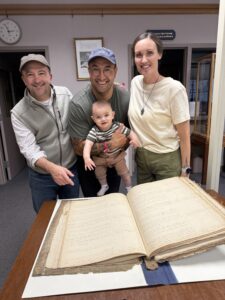
This week, the Collections Research Center hosted a special visit, one that connected Māori New Zealanders Kirby and Isaac Beach and their seven-month-old son, Haimona (Simon), to a logbook in our collection. Kirby and her son are descendants of Elisha Apes, a Pequot whaler who sailed out of New London in the 1830s. In Kirby’s quest to learn about her ancestor, she and Isaac came across the research of Dr. Jason Mancini. Throughout his career, Mancini has explored previously undocumented maritime adaptations of Indigenous social networks that emerged in response to European colonization and land dispossession during the eighteenth and nineteenth centuries. Elisha Apes is one of those stories.
Mancini writes:
It was back in 1839 when Elisha Apes, near the coast of New Zealand, confronted the captain of the New London, Connecticut-based whaleship Ann Maria over his mistreatment of the ship’s apprentice boy. After a brief struggle with the mate, Apes, “an exceptionally big and also very powerful man…[stormed] into the Captain’s cabin and took possession of the firearms.” He and the ship’s carpenter (with whom the initial conflict began) agreed with the captain that they would be “put ashore” at the nearest port. As the Ann Maria approached land, the two men then took a whaleboat with “all their belonging stowed away aboard, firearms, tools, food” and other supplies and rowed into Port Chalmers. There he began a new life in the midst of massive change. Within a year of Apes’ arrival in New Zealand, the Treaty of Waitangi (1840) was signed by Maori leaders and New Zealand was officially (though problematically) absorbed into the British Empire. This agreement precipitated a massive dispossession of the indigenous Maori. Though Apes continued maritime labor for a time, he eventually turned his attention to the land after marrying Mata Punahere, one of the local Ngāi Tahu. The couple had eight children…
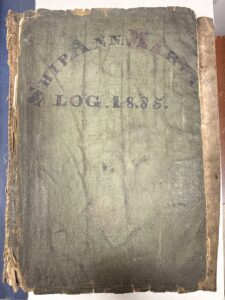
The Mystic Seaport Museum library holds manuscripts documenting two voyages of the Ann Maria (OLog 3), from 1835–1837 and 1837–1839, both contained in a single bound logbook. Apes was aboard the second voyage. The incident Mancini describes, however, took place during the Ann Maria’s 1839–1841 voyage.
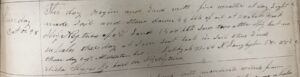
The log of the Ann Maria contains all the details you’d expect in a typical logbook: date, latitude and longitude, whales, weather, and very little personal information. One of those exceptions is a brief note: “Capt. Middleton Let Elisha Heppes Go Bord the Ship Neptune.” “Heppes” is likely a phonetic spelling of Apes, as the other Elisha on board had the last name Buchanan. It is also possible that Apes knew people aboard the Neptune, of New London, which he also sailed on during previous voyages in 1834 and 1836.
We were pleased to welcome Kirby, Isaac, and Haimona, the fourth-great-grandson of Elisha Apes, to the Collections Research Center to connect with a piece of their own story, hidden in the pages of the log of the Ann Maria.
Learn more about local Indigenous whalers and their travels around the globe in the online Resource set: Connecticut Indian Mariners, which features story maps that follow the lives of Peter George, Mashantucket Pequot whaler, and Edward Uncas, Mohegan whaler. You can also hear Mancini’s lecture on the topic: Lecture: Connecticut Indian Mariners. These resources were created through the Mystic Seaport for Educators Project in 2014.
-Krystal Rose, Curator of Collections