
Two summers ago, while sorting through about thirty boxes of uncatalogued shell collections from the CSR basement, one of our summer interns came across this unusual shell with perfectly punched holes. The shell had no associated number, donor, or provenance, but luckily our friend Jim Carlton at Williams-Mystic helped identify this “holy” bivalve as a freshwater mussel shell, likely from the family Unionidae, whose neatly punched holes are remnants of its former life in the pearl button industry. In freshwater, certain types of clams are called “mussels,” which are not related to edible sea mussels.
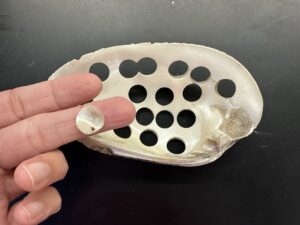
Pearl button production was a thriving industry in the early 1900s, particularly along the inland waterways of the Mississippi and Ohio Rivers. One town in particular, Muscatine, Iowa, became the center of the industry, producing billions of pearl buttons. Photographs from the turn of the century show roads leading to button factories layered with thousands of discarded shells just like this one.
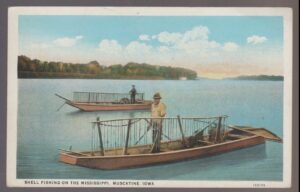
This postcard in our collection, 2025.55, shows mussel fishermen, known as “clammers,” working from small boats using a contraption called a crowfoot bar to gather mussels. Lines fitted with specialized crowfoot hooks were suspended from the bar and dragged along the river bottom. When the hooks encountered an open mussel, the shell would snap shut around them. Clammers also used scissor forks or shell tongs and sometimes waded through the river searching for mussels with their feet, a technique known as “polly wogging.”
Once the mussels were harvested, cleaned, and the shells separated, the shells were sometimes sent to small cutting shops where workers cut circular “blanks” using specialized shell-cutting saws. These saws were sprayed with water during cutting to reduce heat and dust. Larger factories handled every stage of production, from cleaning shells and cutting blanks to finishing the buttons. Many finishing tasks, including polishing and decorative work, were carried out by women.
Carefully mounted onto button cards decorated with company names like U.S. Button, Hawkeye, and American Maid, what were once thriving bivalves on the river bottom traveled around the world as lustrous, beautifully designed buttons.
The pearl button industry along America’s inland waterways began to decline in the 1930s and 1940s due to overharvesting, overseas competition, changing fashions, and the introduction of new materials like plastic. About a dozen mussel species were heavily harvested for button production, and many of them remain endangered today, facing ongoing threats from pollution and invasive species.
While we may never know the exact origins of our shell, we are pleased to have it in the collection as a reminder of the once-thriving pearl button industry and the freshwater mussels that made it possible. You may even have mussel pearl buttons in your button box, especially if you have buttons passed down through the family!
Learn more in this short video from Iowa PBS:https://www.pbs.org/video/national-pearl-button-museum-ifk4af/.
-Krystal Rose, Director of Collections & Curatorial Affairs