
This week’s From the Vault is tied to the origins of the “vault” itself. As many of you know, our collections of art, objects, manuscripts, ship plans, photographs, and more are housed across the street from the main campus, within high-security rooms, or “vaults,” in the historic mill building. Today, inside the mill, you’ll find shelf after shelf of meticulously organized objects that reflect American maritime material culture, but in the spring of 1898, it was bustling with looms and workers during its early days as the Rossie Velvet Mill.
The Mill was founded by the Rossie family of Germany (who were known for operating textile mills there), with financial backing from the Mystic Industrial Corporation. Two of the Rossie sons, John and Ernest, served as general managers. The mill began operations with 100 employees and grew to between 500 and 600 workers at the height of production in the 1920s. The company played a significant role in Mystic’s economic recovery following the decline of the shipbuilding industry in the early twentieth century.
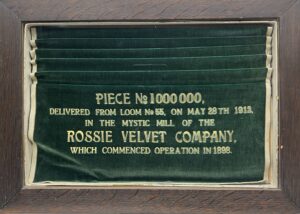
Velvet “Piece No. 1000000” (1978.3), beautifully folded and framed, was acquired by the Museum curator in 1977 for $38. The company keepsake, featuring elegant gold lettering, reads: “DELIVERED FROM LOOM No. 55, ON MAY 28TH 1913, IN THE MYSTIC MILL OF THE ROSSIE VELVET COMPANY, WHICH COMMENCED OPERATION IN 1898.” During a recent condition report, Collections Manager Chris White discovered an additional label indicating that the color is “Shade 191.”
Velvet produced at the Rossie Mill was renowned for its superior quality, particularly during the Rossie brothers’ leadership. This reputation was achieved in part through the company’s practice of limiting the number of looms assigned to each weaver. An innovator in textile manufacturing, the company was among the earliest producers of spot-resistant velvet and also experimented with nylon and crush-resistant velvets.
Although it may not be immediately apparent, every piece of velvet produced at the mill was deeply connected to the maritime world. Dyes were shipped from Europe, while other supplies arrived by coastal schooner and barge. The industry also left its mark on the local marine environment. When dye baths were no longer usable, their contents were dumped into the Mystic River estuary. In an oral history interview in our collection, a resident remarked that it “colored all the clams out there.”
The Rossie Velvet Mill ceased production in 1958, but you can learn more about the company and the region’s textile manufacturing history this summer in Luxe CT: Velvet Mills to Modern Runways at the Mystic Museum of Art. The exhibition features this piece of velvet alongside other artifacts and photographs from Mystic Seaport Museum.
-Krystal Rose, Director of Collections & Curatorial Affairs