
The albatross has long been a source of superstition and mystery for those who go to sea. With an almost supernatural presence, this enormous seabird, with a wingspan of up to twelve feet, can glide behind a ship for hours, barely flapping its wings.
Some mariners believed the albatross carried the souls of dead sailors and, depending on the circumstances, could be either an omen of good fortune or a warning of disaster.
Mentioned throughout maritime logbooks and literature, the albatross plays a prominent role in Samuel Taylor Coleridge’s The Rime of the Ancient Mariner. When the magnificent bird first appears, the sailors welcome it with delight:
At length did cross an Albatross,
Thorough the fog it came;
As if it had been a Christian soul,
We hailed it in God’s name.
Without explanation, the Ancient Mariner kills the albatross. As punishment, the dead bird is hung around his neck, and he and his crew are plagued by misfortune.
For a bird whose death was believed to bring bad luck, we have an unusual number of albatross remains in the collection.
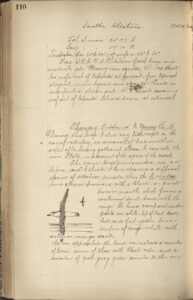
As one might suspect, albatrosses appear frequently in sailors’ logbooks and journals, both in written accounts and in marginalia sketches. One example is this 1886 drawing and description by William Edwin Safford, who was aboard the U.S.S. Vandalia. If you visited the Spineless exhibition, you might remember this journal and Safford’s darling drawings of nudibranchs, hydroids, and siphonophores that were featured.
Among the more interesting accounts, Captain Fred Smith recorded in the logbook of the whaleship Ohio that he killed an albatross on December 26, 1876. His wife, Sallie, also noted the event in her journal, and the couple kept the skull (1941.356), complete with its bill, as a curious souvenir.
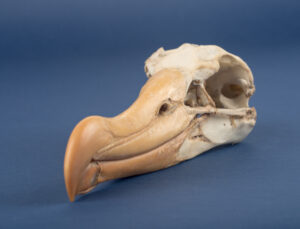
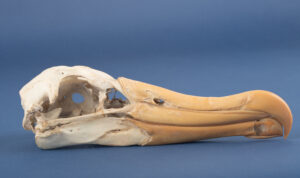
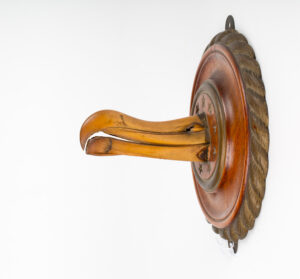
The Museum also holds an albatross bill plaque (1936.133) that belonged to Captain T. Turner of Norwich. Both objects preserve the bird’s distinctive external tubular nostrils, which help albatrosses detect scents over vast stretches of ocean and excrete excess salt from the seawater they ingest.
Albatross eggs even found their way into the Museum’s collections. At least four of the twenty-two species of albatross are represented in eggs collected by Joseph Beecham before 1885: Tristan Albatross (Diomedea dabbenena), Wandering (Snowy) Albatross (Diomedea exulans), Atlantic Yellow-nosed Albatross (Thalassarche chlororhynchos), and the White-capped Albatross (Thalassarche cauta). (2020.35 coll)
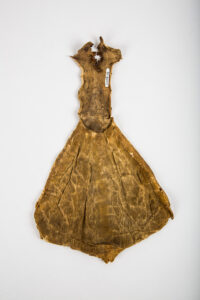
One of the most surprising keepsakes is an albatross foot pouch (2008.16), donated to the Museum with only the note: “Albatross foot / Carried in days of ’49 / to hold gold dust.” While it might seem like an eccentric object fashioned out of boredom at sea, sailors commonly turned albatross feet into tobacco pouches by removing the bones and carefully preserving the skin. Ours is fairly simple in design, but other museums have examples fitted with drawstrings and even ornate metal frames. The donor’s note suggests it was used to hold gold dust during the Gold Rush, but it may instead have been intended for “gold dust” tobacco. With no trace of either remaining inside, the pouch leaves its true purpose a mystery.
-Krystal Rose (Adapted from an article written for the Mystic Seaport Museum Magazine)