
“A splendid pleasure of Ruth Nichols, the well known aviatrix, Homer Seider and myself, standing alongside Swordfish. She is wearing my boots and her flying suit. The weather was ideal and she enjoyed the sport very much. Note the laminated runner plank and lead weight over the runner.” (From George J. Seger Ice Boating Album, MSM Collection, 1997.27.770)
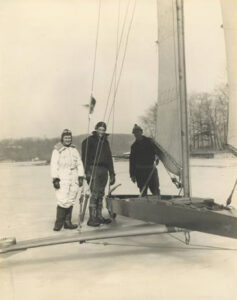
Ruth Nichols (1901–1960) stands as one of the most dynamic and determined figures of early American aviation, a pioneer whose story is deeply intertwined with Long Island’s formative role in flight history. Her autobiography, Wings for Life, vividly captures a world in which aviation was still experimental, dangerous, and exhilarating, a world centered in places like Long Island, where Nichols honed her skills and forged lasting connections. Today, a striking photograph in the collection of Mystic Seaport Museum, showing Nichols in her flying suit beside noted ice boat racer George J. Seger, who took her for a ride on the ice, offers a compelling visual link between her aviation career and the broader culture of speed, innovation, and adventure that defined the coastal Northeast. Her ride aboard the ice boat echoes the same thrill she described in flight, particularly in her vivid recollections of crossing Long Island Sound at sunset, when “brilliant splashes of purple, red and yellow” streaked the sky and reflected across the water, moments she believed “keep pilots in the air.”
Long Island was not merely a backdrop but a central stage in Nichols’s aviation career. She frequently traveled between Rye, New York, and aviation centers such as Port Washington and Roosevelt Field, then one of the nation’s leading hubs of flight. There she immersed herself in the culture of early aviation, collecting aircraft parts, exchanging stories in hangars, and participating in the essential practice of “hangar flying.” Off the waters of Port Washington, she completed the demanding Fédération Aéronautique Internationale (FAI) flight test required for her pilot’s license. The examination demanded precision, endurance, and independence, reinforcing her place among the most accomplished pilots of her generation.
Nichols’s influence extended beyond her own flying to the institutions that shaped aviation. She helped found the Aviation Country Club in Hicksville, an early effort to formalize aviation as both a sport and a social community. She also played a key role in establishing the Ninety Nines, the pioneering international organization of women pilots cofounded with Amelia Earhart. The group held its first meeting at Curtiss Airport on Long Island in November 1929, with twenty-six women attending in person and many others participating by correspondence. The organization’s name was chosen shortly afterward to reflect its ninety-nine charter members. Nichols remained active in its leadership and later helped establish the Amelia Earhart Scholarship Fund following Earhart’s disappearance in 1937.
Her commitment to aviation also took on humanitarian dimensions. In 1940, Nichols organized a large-scale disaster relief exercise in Greenport involving approximately one hundred aircraft responding to a simulated hurricane. Widely reported at the time, the event demonstrated the potential of organized civilian aviation during emergencies and advanced the mission of Relief Wings, the organization she founded to promote emergency air services. Her vision of “mercy flying” reflected both her personal experience and her belief that aviation could serve the public good.
The professional connection between Long Island and Connecticut forms another important thread in Nichols’s story through Bradley Field, now Bradley International Airport. In 1932, she piloted the inaugural flight of a new airline route between Holmes Airport in Jackson Heights, Long Island, and Hartford, Connecticut, becoming one of the first women to fly commercial passenger service in the United States. Bradley Field appeared again later in her life as both the departure and return point for her 1949 global humanitarian mission on behalf of UNICEF. After surviving a dramatic transatlantic ditching, she ultimately returned safely to Bradley Field, reinforcing its importance as an aviation link between Connecticut and Long Island.
Among Nichols’s greatest accomplishments were multiple world aviation records for speed, altitude, and distance between 1929 and 1931, making her one of the foremost pilots of her era. She was the only woman known to hold simultaneous world records in all three categories. She also became the first licensed woman seaplane pilot in the United States, the second government licensed woman land plane pilot, the first woman airline pilot in the United States, and the first woman to fly a seaplane carrying air mail from New York State. As a founding member and leader of the Ninety Nines, she expanded opportunities for women in aviation. Her humanitarian work proved equally significant through Relief Wings and her later global mission for UNICEF documenting conditions affecting children around the world. Despite surviving several serious crashes, including one that left her with a broken back, she returned to flying while wearing a supportive brace. These achievements represent only part of her remarkable legacy as an aviator and humanitarian.
Throughout her life, Nichols balanced an enduring passion for flight with a strong sense of responsibility to her family. She often reflected on the tension between those commitments but remained convinced that perseverance would ultimately be rewarded. As she wrote, “if you just hold on long enough, there’s always something wonderful around the corner.” That philosophy carried her from the airfields of Long Island to the global stage and continues to resonate through the collections and interpretation of Mystic Seaport Museum, where her story connects the worlds of sea, sky, and human ambition.
In this light, the photograph of Nichols standing beside George J. Seger and the ice boat Swordfish comes into sharper focus, not as an incidental moment but as a fitting symbol of the experiences and culture that shaped her. On the ice, as in the air, Nichols embraced speed, risk, and exhilaration, her borrowed boots and flying suit underscoring the close relationship between these pursuits. The image captures the same spirit she described while flying over Long Island Sound, illustrating her deep connection to a regional tradition of innovation and adventure driven by wind, water, and an unrelenting desire to push boundaries.
-Kate Katin, Curator of the Long Island Collection
The Long Island Collection is generously supported by the Robert David Lion Gardiner Foundation.
The Robert David LionGardiner Foundation supports the study of Long Island history and its role in the American experience. Please visit www.rdlgfoundation.org for more information.
Visit https://research.mysticseaport.org/collections/long-island-collections/ to learn more.