
Happy Thanksgiving from the Collections Research Center!
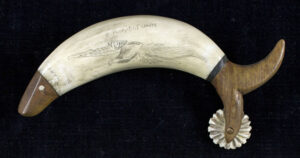
It’s that time of year again – the leaves are brown, temperatures are dropping, it’s getting darker earlier (and earlier!), and ovens are preheating for Thanksgiving dinner. As we prepare to celebrate the holiday, whether with family, friends, pets, or all three, let’s take a moment to explore the maritime connection between a classic American dessert and the whaling industry.
A Short(crust) History
Although pie and whaling may seem unrelated, the connection between the dish and maritime history dates back hundreds of years—to when the pie crust was inedible and called a “coffyn.”
Historically, what we now call the pie crust was not intended to be eaten; it was merely the cooking vessel and storage container. A mixture of water and milled grains, such as rye, barley, oats, or wheat, or alternatively dried beans or peas, would be used to create a shell in which to cook a filling of meat, fruit, or a mixture of the two. Essentially, the pastry coffyn replaced the earthenware or glass pie plates we’d use today to provide structure to the pie. As such, to properly hold the often heavy filling, the pastry shell needed to be thick, strong, and hard on the outside. Not something that would be particularly appetizing.
Despite not adding to the flavor of the pie, the coffyn also preserved the filling by creating a sealed environment. Pies were, as a result, incredibly convenient for long voyages at sea, as they mitigated the need to keep as many ingredients on board, including livestock, as well as employ a cook; instead, they were compact, stackable, left little waste, and were, for the most part, well-seasoned and nutritious.
Sailing the Pie Seas
Flash forward to the 19th century – pie continued to be a staple in American meals, whether savory or sweet. However, the crust now resembled what we are more familiar with today, with the inclusion of some kind of fat (butter, lard, suet, etc.). Adding fat to the dough made it more pliable, too; it was no longer a race against time to make the crust before the dough dried out. Pie dough could be cut into shapes, stamped, woven, poked, and more to create one-of-a-kind dishes to enjoy.
At the same time, the whaling industry was booming. With voyages ranging from six months, on the short end, to four years, it was typical for the crew to have long periods of downtime between whale sightings. As a by-product of whaling, whalebone, teeth, baleen, and the bones of other marine mammals were common on board, but not particularly useful. Rather than disposing of these materials, however, whalers used the bones as a canvas. They transformed teeth by carving or engraving them into decorative pieces or utilitarian objects that they could then sell or give as tokens to family and loved ones. With how crucial pie was to the diet of the 19th-century American, jagging wheels, also referred to as pie crimpers or pastry wheels, became one of the most common pieces carved by whalers.
A Wheel-y Good Multitool
Jagging wheels, at their core, were tools intended to cut pastry dough. However, whalers had the time to innovate – adding numerous other features and turning the jagging wheel into a pastry multitool.
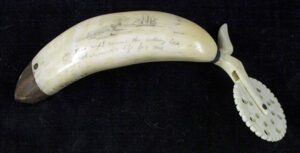
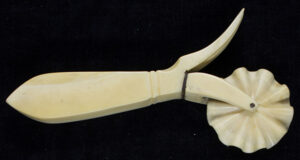
The main element of the tool, the wheel, was often fluted, creating a wavy or “jagged” edge; some scrimshanders even added multiple wheels, each with its own pattern variation. In the examples below from the collection, notice how the wheels differ: the first wheel would cut a smooth wave into the dough, while the second would create a sharper zigzag. The third photograph depicts a jagging wheel with two wheels; however, these are placed parallel to each other to create strips of dough which could then be woven into a lattice or braided.
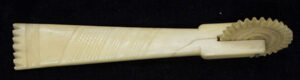
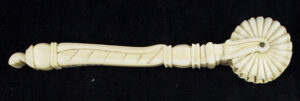
A common feature added to jagging wheels was forks, often on the opposite end or jutting out beside the wheel. The fork-like tines were used to seal crusts together or poke steam vents. Without these extra steps, a double-crust pie might seep at the edges or rupture due to steam being trapped. As such, a quick press around the perimeter and poke in the center goes a long way to prevent a pie disaster.
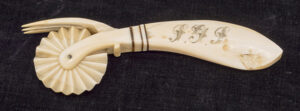
Other elements added to jagging wheels were knives to cut excess pastry or create further decorative pie elements, and tart tampers that sometimes doubled as dough stamps.
Don’t Crimp my Style
It’s hard to look at scrimshaw jagging wheels and not comment on their uniquely complex, beautiful, and sometimes odd designs. Jagging wheels became objects where scrimshanders could display the skills they honed while at sea. Intricate carvings, etchings, cut-outs, inlays, and the like can be seen in jagging wheels within Mystic Seaport Museum’s collection. Below are some of my favorite examples from the collection.
Starting off simple, the pie crimper below cuts a straight line as it rolls, while also stamping “GOOD PIE WELL MADE” on the dough.
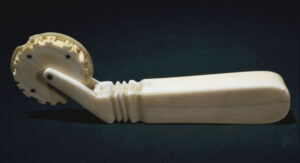
This double-wheel example demonstrates the scrimshander’s multiple skills, including tortoiseshell inlay, mother-of-pearl (reverse side), and an etched portrait of a boy. Each wheel cuts a different pattern, while the three-tined fork can be used to add finer details.
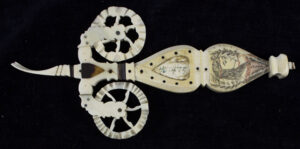
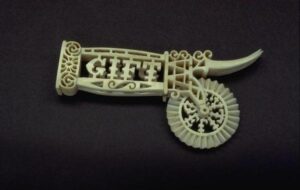
One of the more intricately carved wheels in the collection, this jagging wheel was likely a gift to the scrimshander’s wife, maybe even a wedding gift based on the specific carvings. The spokes of the wheel spell out “FIDELITY”, while the dates “JULY, 15” and “1857” are carved into the narrow sides and bottom of the handle, respectively. The handle is also openly carved with “GIFT” on one side, and the initials ‘P. H. R’ on the reverse.
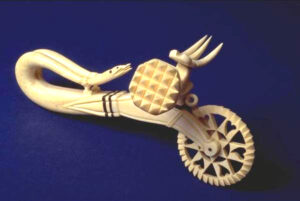
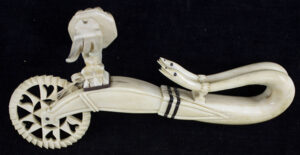
Interestingly, serpentine creatures were common motifs on jagging wheels. In this example, the handle is formed by two snakes with baleen inlay eyes and nostrils. Baleen is also inlaid around the handle in two parallel stripes. Beyond the aesthetic choices, this example includes a wheel, fork, and spiked tamper. Additionally, the jagging wheel could be hung from the opening created by the curve of the snakes.
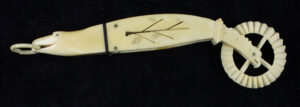
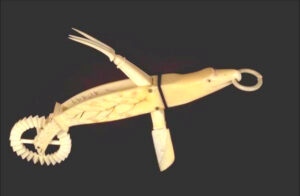
Finally, we have possibly the most unique jagging wheel in the collection. Although it may not look as complicated as some of our previous examples at first glance, the carved eagle has not taken flight yet. Turning the tool to the side reveals its “wings” – a three-tined fork on one side and a pastry knife on the other. The pie crimper is complete with a zig-zag pattern wheel and cut outs on the handle resembling trees.
If you’re still hungry for jagging wheel history, check out the Mystic Seaport Museum for Educators’ deep dive: Ivory Jagging Wheel with Woman’s Leg Design (1989.71.7)!
–Jenny Carroll, Collections Cataloger