
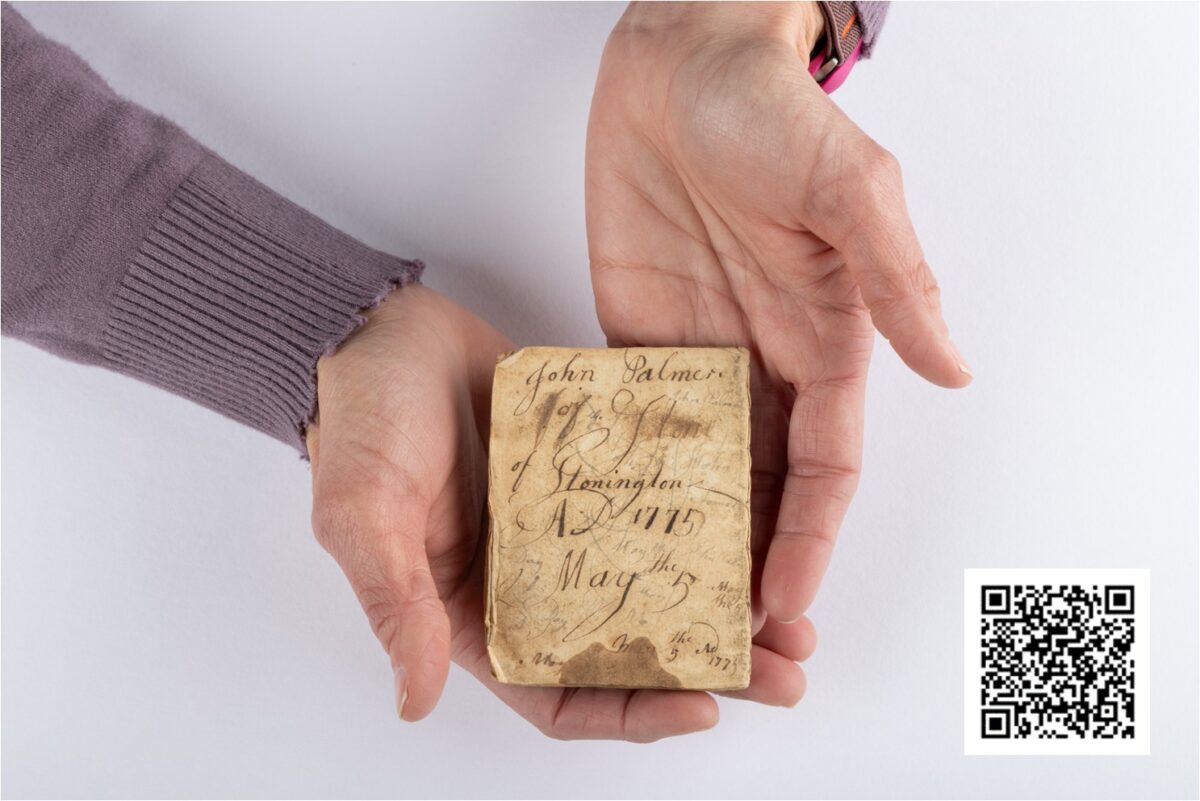
If you’ve had a chance to explore the new Fo’c’sle to Farmhouse exhibit in the Pilalas Lobby in the Thompson Exhibition Building, you may have noticed a very small journal filled with tiny, almost illegible notes that make you squint your eyes. Displayed in the case on the right, this pocket journal belonged to John Palmer (1757–1788) of Stonington.
Palmer enlisted in the 3rd Company of the 6th Connecticut Militia on May 5, 1775. He departed New London, Connecticut, for Boston on June 26, just days after the Battle of Bunker Hill on June 17, and arrived on June 30 to join American forces during the opening phase of the Siege of Boston. This little journal chronicles much of his experience from May through November 1775. Palmer’s entries describe skirmishes, cannon fire, and raids on British positions, along with a severe outbreak of dysentery, known at the time as the “bloody flux,” that swept through both British and American camps during the summer.
After serving in the Continental Army as part of Colonel Henry Babcock’s regiment at Newport, Rhode Island, he shifted to privateering. From 1777 to 1778, he served aboard the Stonington privateer Revenge. Palmer later served aboard merchant vessels out of Stonington and New London on West Indies trading voyages between 1779 and 1785. He died at the age of 31 in 1788 and is buried nearby in Stonington Cemetery.
You can follow some of the events recorded in Palmer’s pocket journal by visiting the interactive Map of Events in John Palmer’s Pocket Diary. Then stop by and see the journal in person while it is on display this summer!
Fun (and Slightly Confusing) Fact:
Researching the John Palmer Collection quickly revealed that Revolutionary-era Stonington had more than a few John and Jonathan Palmers running around. Our John Palmer and Jonathan Wait (or Wiatt) Palmer (1739–1782) both served in the 3rd Company of the 6th Connecticut. “Colonel” Jonathan Palmer Jr. (1747–1810) served in the 5th Company of Groton, as well as in the Stonington militia in 1775. Our library even holds a book analyzing a similar journal kept by him: Colonel Jonathan Palmer’s War Diary by Norman F. Boas, published in 1985. That diary, which was privately owned, sold at auction about ten years ago. To make things even more confusing, a fourth Palmer, Captain Jonathan Palmer (1720–1803), was the father of Colonel Palmer, and captain of the 6th Company of the Stonington militia.
–Krystal Rose, Director of Collections & Curatorial Affairs