
Today we celebrate the 126th birthday of ichthyologist and conservationist, Gloria Hollister, who was born on June 11, 1900. As a child, Hollister dreamt of being a scientist, at one point even repurposing an oil can to use as a diving helmet to study what lay at the bottom of the Mahwah River. In 1924, Hollister graduated from Connecticut College, then Connecticut College for Women, with a B.S. in Zoology; a year later, she acquired an M.S. in Zoology from Columbia University.
In 1928, Hollister was offered the opportunity of a lifetime, one that would harken back to her childhood dives. Hollister was hired as a research associate under William Beebe, who is now considered one of the founders of the field of ecology. Beebe sought to document deep-sea creatures as they had never been before. The Bathysphere, a first of its kind deep-sea submersible designed by Otis Barton, would allow deep-sea creatures to finally be observed in their natural habitat.
As part of her role during the Bathysphere project, Hollister acted as a transcriber. Communicating with Hollister via telephone wire, Beebe and Barton would relay what they were observed from the Bathysphere back to the surface. Hollister additionally studied the bone structure of fish and other sea creatures, even refining the technique of “clearing and staining” specimens which rendered the skin, flesh, and internal organs of fish transparent, allowing for easier study of their skeletons.
In Gloria Hollister’s personal papers, now at the Library of Congress, she wrote about the Bathysphere, “It is the desire of my life, at present, to descend in this ball and see with my eyes and not my imagination. There is no reason why I should not, I am quite independent…” (May 31, Box 2, Gloria Hollister Anable, Manuscript Division, Library of Congress, Washington, D.C.).
On June 11, 1930 – her 30th birthday – she got her wish. About her first dive, Hollister recalled:
We watched a school of colorless shrimps pass in the distance and a startled carangid-like fish as he butted savagely against the window and darted away into blue space. It was difficult to believe that these creatures and hundreds of others could exist in this world of strained sunlight, constant cold, and enormous pressure. (Hollister, Gloria. Bulletin of the New York Zoological Society. “Telephoning to Davy Jones’ Locker, Log of the Bathysphere Dives.” November-December 1930)
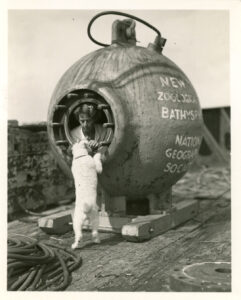
Hollister would dive twice more in the Bathysphere, descending to 1,000 feet in 1932 and 1,208 feet in 1934, each time setting the record for the deepest dive completed by a woman. In this photograph in our collection, accession number 2023.49, Hollister is shown sitting inside the Bathysphere onboard the Ready in 1934, reaching out to her terrier, Trumps.
In her later life, Hollister turned her efforts towards conservation. In the 1950s, she formed the Mianus River Gorge Conservation Committee to protect the ecological diversity of the gorge. The Mianus River Gorge became the first land acquisition of the non-profit The Nature Conservancy, and the first National Natural Landmark designated by the Department of the Interior. Though she may not be a household name, Gloria Hollister’s legacy is visible throughout the marine sciences and conservation fields, and her impact as a female scientist will continue to pave the way for generations of women.
-Jenny Carroll, General Collections Cataloger