
Today, Juneteenth, is an important celebration and day of remembrance, commemorating the end of slavery in the United States. As we reflect on the shortcomings of American history, stories of fortitude and empowerment are resounding, as displayed in the recent Museum exhibit Entwined. The Collections Research Center vault is also home to belongings of significance to the desegregation of the United States Navy.
In 1893, the U.S. government imposed a segregation-based restriction on the Navy and created the Messman’s Branch. From 1919 to 1932, Black sailors were prohibited from enlisting entirely. While enlistment resumed, Black sailors who joined the U.S. Navy faced significant segregation, limited to positions in the Messman’s and Steward’s Branches. On land and at sea, living quarters were separate and often disparate in quality. In 1941, F.D.R. signed an executive order prohibiting racial and ethnic discrimination in the defense industry. The following year, in response to protests from the Civil Rights movement leaders of the time, Black sailors were allowed to enlist for general service positions. In 1944, pressure from Eleanor Roosevelt—as evidenced in memoranda in the Museum’s collections—and Naval Secretary Adlai Stevenson led to the formation of the first class of Naval officer training courses opened to Black sailors.
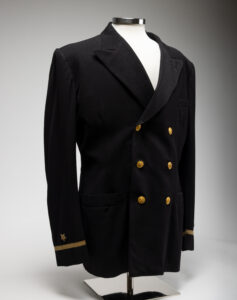
Sixteen Black sailors met at Camp Robert Smalls in Illinois to complete their training, but the usual 16-week course had been condensed to 8. The sailors were given half the amount of time allotted to white sailors. Determined to not let this bar them from rightful positions, they stayed up through the night, helping one another with their weaknesses. Each one of the 16 men scored extremely highly on their tests. Unfortunately, this success was met with disbelief, then resistance, from those higher in the chain of command, leading to a forced retest. Once again, this group achieved unprecedented high scores. Only 13 of the sailors were commissioned as officers with no official explanation as to why. These men are remembered in history as the Golden 13. Here at the Museum, we have the uniform of Golden 13 officer Frank Sublett, Jr., who, like the rest of the 12, served in WWII. He can be seen wearing the uniform in this photograph. Sublett is in the top row at far right.

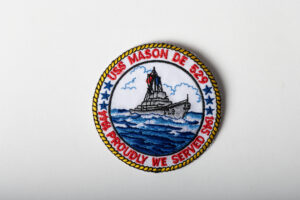
Another member of the Golden 13, James Edward Hair, joined the crew of the U.S.S. Mason (DE 529), the first predominantly Black naval combat vessel to serve overseas. The men of the Mason had to face racist attacks from fellow Americans, while the attacks of World War II continued. One of the many examples of these men’s bravery is the story of N.Y. Convoy 119. A severe storm hit this convoy, leaving the Mason with significant hull damage. Other escort vessels turned away, unable to fulfill their duties in this mission. The crew repaired a cracked hull while still at sea, escorted vessels to shore, and turned back again to retrieve stragglers. A commendation was written, to be awarded at the close of the war, but was “lost”. No formal recognition was given to these men until the 1990s, after years of advocacy by members and supporters, including James W. Graham, Gordon Buchanan, Barbara Graham, and Lorenzo DuFau. By this time, many of the sailors and their loved ones had passed. The Museum holds a collection of U.S.S. Mason materials and an oral history, thanks to James and Barbara Graham, including the patch pictured here.
This Juneteenth, we recognize the resilience of Black sailors in the American Navy and their perseverance, both domestically and overseas, by sharing a seldom-discussed story of an important Civil Rights battle. Help celebrate by sharing the story of the Golden 13 and U.S.S. Mason, and of your own communities, ancestors, and inspirations of Black resilience. Happy Juneteenth.
This week’s From the Vault is brought to you by Makenzie Metivier, Collections Assistant and Special Collections Cataloger.
Last week’s article on Gloria Hollister was by Jenny Carroll, General Collections Cataloger.
Previous stories on the Rossie Mill commemorative velvet, the pearl button mussel shell, and John Palmer’s pocket journal were by Krystal Rose, Director of Collections & Curatorial Affairs.